
The Charges Hiding on Your Utility Bill That Aren't Actually Electricity
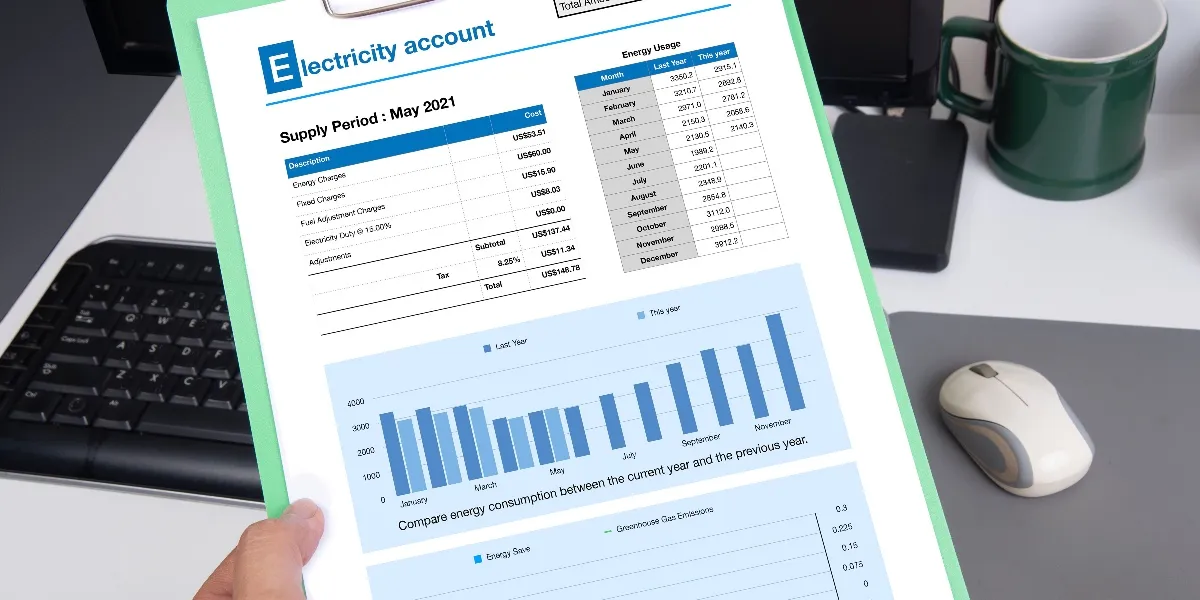
Open your utility bill and scan past the total to the itemized breakdown, and you'll usually find your bill splits into more categories than you'd expect for something that's supposedly just "the electric bill." Some of those categories are unavoidable. A few are worth questioning directly with your provider.
The most fundamental split worth understanding is between supply and delivery. Supply is the actual electricity you consumed, priced per kilowatt-hour. Delivery covers the infrastructure that gets it to you, the poles, wires, transformers, and maintenance that your local utility maintains regardless of who supplies your actual power. In states with deregulated electricity, only the supply portion is something you can shop around for, the delivery charge stays the same no matter which supplier you choose, since there's no competing infrastructure running to your house.
Fixed monthly charges show up on nearly every utility bill regardless of usage, and they're worth locating specifically since they're easy to overlook when you're only checking the total. A basic customer or service charge, sometimes called a meter fee, applies just for having an active account, independent of how much electricity, gas, or water you actually use that month. This fee generally can't be avoided or negotiated away, but it's worth knowing it exists so a low-usage month doesn't leave you confused about why the bill isn't proportionally lower.
Taxes and regulatory fees make up another layer, and these vary significantly by state and municipality. Some jurisdictions apply a utility tax as a percentage of your bill, others tack on specific regulatory or franchise fees tied to how the utility operates in that area. These aren't something your provider controls or can waive, but they're worth understanding so an unexpectedly high bill isn't automatically assumed to be a usage or rate problem when it might just reflect a local tax change.
A few charges genuinely worth double-checking and, in some cases, disputing directly with your provider:
- Late fees and reconnection charges, which can compound quickly if a payment is missed, worth calling immediately if you're at risk of missing a due date, since many utilities offer a grace period or payment plan if you ask before the deadline rather than after
- Estimated billing discrepancies, if your utility doesn't read your meter every month and instead estimates usage between reads, a subsequent actual reading can produce a larger-than-expected true-up charge, worth confirming your bill is based on an actual read versus an estimate if a bill looks unusually high
- Budget billing true-ups, if you're on a levelized payment plan meant to smooth out seasonal highs and lows, an annual reconciliation can produce a lump-sum adjustment if your actual usage ran higher than the averaged estimate assumed
If you're in a deregulated market and haven't compared suppliers recently, that's the single biggest lever for actually lowering the number rather than just understanding it better. Customers who shop and switch typically save 10% to 20% on the supply portion specifically, since that's the only piece of the bill where competition exists at all.
A practical way to actually read your own bill for the first time: pull out the supply rate specifically, listed as a per-kilowatt-hour or per-therm price, and compare it against your utility's default rate or a competing supplier's advertised rate if your area allows choice. Everything else on the bill, delivery, fixed fees, taxes, is largely fixed regardless of supplier, so that one rate is where your actual control over the bill lives.
Calling your utility directly and asking for a plain-language walkthrough of every line item on a recent bill is a legitimate request, not an unusual one, and most customer service representatives can explain each charge in a few minutes over the phone. It's a small step that turns a confusing bill into something you actually understand, and it's the only way to know for certain which charges are fixed and which, if any, are actually worth questioning for your specific account. Keep notes from that call too, the name of whoever you spoke with and the date, in case a similar question comes up again down the road. That small habit makes any future call to the same utility considerably faster and less frustrating than starting the entire explanation over again from scratch each time you call. It's a small piece of upkeep that pays off the next time something on the bill genuinely doesn't add up the way you expect it to.